Get our free email course, Shortcut to Conversational.
Have conversations faster, understand people when they speak fast, and other tested tips to learn faster.
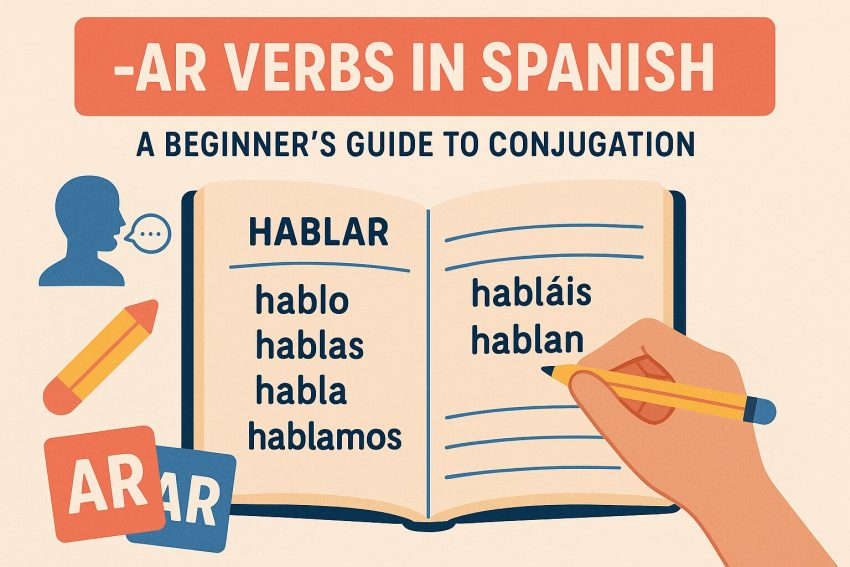
Spanish verbs like hablar, bailar, and nadar belong to the largest group of verbs in the language: -AR verbs in Spanish. Since most verbs follow this pattern, mastering -AR verbs is one of the fastest ways to start speaking Spanish.
In this guide, we’ll explain what -AR verbs are, show you how to conjugate them in the present tense, and give you plenty of examples and easy tips, including a video on the 44 most common -AR verbs in Spanish. By the end, you’ll be ready to use these verbs confidently in your Spanish sentences.
What are -AR verbs in Spanish?
In Spanish, every verb in its infinitive (basic) form ends in -ar, -er, or -ir. For example, hablar means “to talk,” comer means “to eat,” and vivir means “to live.”
Some common -AR verbs you might already know include:
- hablar (to speak)
- estudiar (to study)
- necesitar (to need)
- cantar (to sing)
- bailar (to dance)

Now, let’s see how to use these verbs by conjugating them in the present tense.
How to conjugate -AR verbs in Spanish (present tense)
In Spanish, the verb ending changes for each subject pronoun.
Regular -AR verbs all use the same set of endings in the present tense.
To conjugate a regular -AR verb in the present tense, just drop the “-ar” ending from the infinitive and add the appropriate ending for the subject. Think of it like a puzzle: you remove the -ar piece and snap on a new ending.
Here are the present tense endings for -ar verbs, using hablar (“to speak”) as an example:
| Subject | Ending | Example (hablar) |
|---|---|---|
| Yo | -o | hablo |
| Tú | -as | hablas |
| Él / Ella / Usted | -a | habla |
| Nosotros/as | -amos | hablamos |
| Vosotros/as | -áis | habláis |
| Ellos / Ellas / Ustedes | -an | hablan |
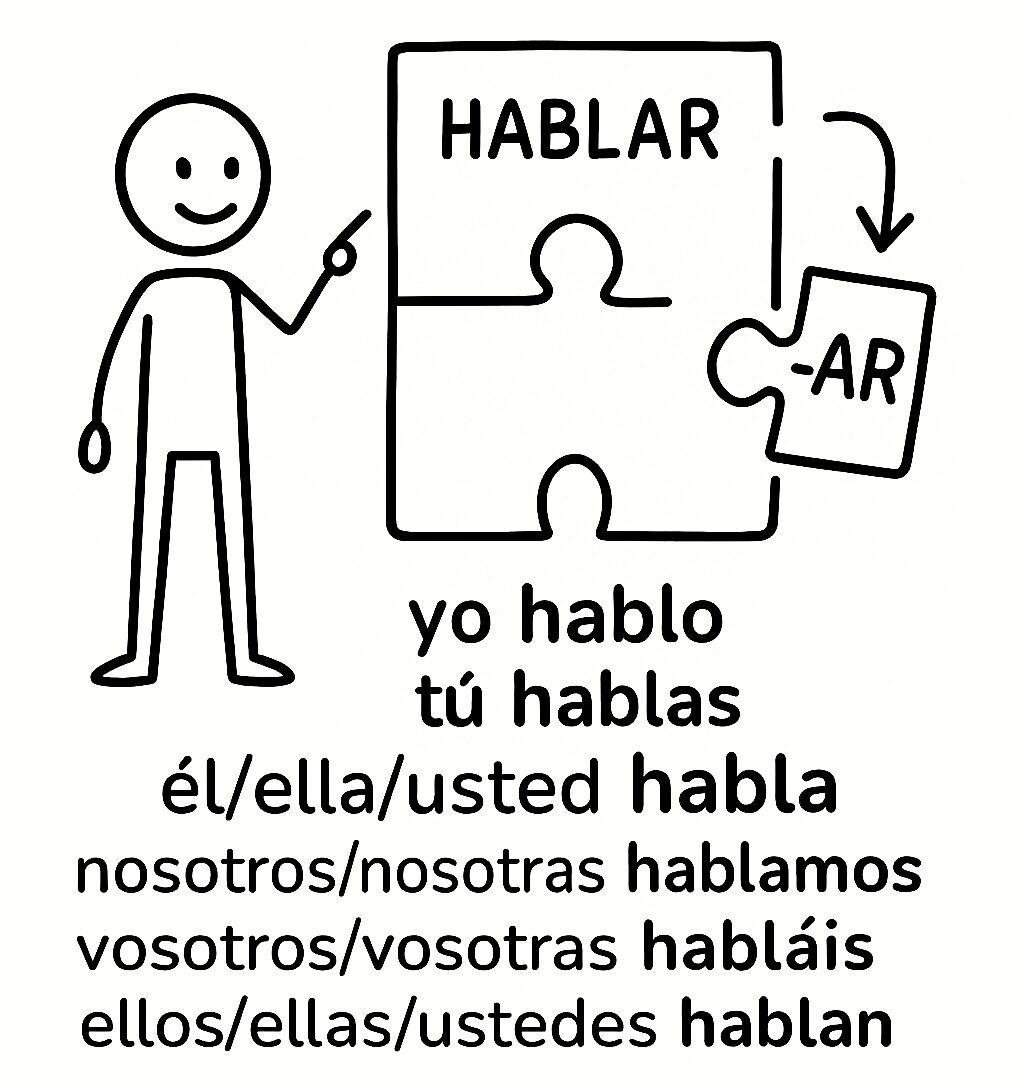
Notice how the verb stem (habl-) stays the same, and only the ending changes for each subject.
For example, habl- becomes hablo, hablas, habla, etc. This pattern is the same for every regular -AR verb.
So if you know hablar → hablo, hablas, …, you can do the same with bailar → bailo, bailas, … (to dance), estudiar → estudio, estudias,… (to study), and so on.
One important thing to remember: in Spanish you often don’t need to say the pronoun (yo, tú, él, etc.) in front of the verb. The verb ending itself tells you who the subject is.
For example, you can just say “Hablo español” instead of “Yo hablo español.” Both mean “I speak Spanish,” but the -o ending in hablo already indicates that the subject is “yo” (I).
Similarly, “¿Hablas inglés?” means “Do you speak English?” – we know it’s “you” (tú) because hablas ends in -as (the tú ending).
Examples:
- Hablamos en la clase. – “We speak in class.”
- ¿Cantan ustedes en la fiesta? – “Are you all singing at the party?” (The verb cantan ends in -an, which tells us the subject is “you all” or ustedes.)
Keep in mind that you would most commonly use vosotros instead of ustedes for the second person plural in Spain.
10 common -AR verbs in Spanish
There are hundreds of -AR verbs, but you don’t need to learn them all at once. Here are 10 super common -ar verbs that beginners will find useful:
| Verbo | Conjugaciones |
|---|---|
| Hablar (to speak) | hablo, hablas, habla, hablamos, habláis, hablan |
| Estudiar (to study) | estudio, estudias, estudia, estudiamos, estudiáis, estudian |
| Necesitar (to need) | necesito, necesitas, necesita, necesitamos, necesitáis, necesitan |
| Cantar (to sing) | canto, cantas, canta, cantamos, cantáis, cantan |
| Bailar (to dance) | bailo, bailas, baila, bailamos, bailáis, bailan |
| Comprar (to buy) | compro, compras, compra, compramos, compráis, compran |
| Trabajar (to work) | trabajo, trabajas, trabaja, trabajamos, trabajáis, trabajan |
| Mirar (to watch) | miro, miras, mira, miramos, miráis, miran |
| Escuchar (to listen) | escucho, escuchas, escucha, escuchamos, escucháis, escuchan |
| Ayudar (to help) | ayudo, ayudas, ayuda, ayudamos, ayudáis, ayudan |
Notice how the endings are always the same:
-o, -as, -a, -amos, -áis, -an.
Once you memorize these, you can conjugate almost any regular -AR verb in Spanish!
What about irregular -AR Verbs in Spanish?
So far, we’ve looked at regular -AR verbs, the ones that follow the same predictable pattern. But Spanish also has some irregular -AR verbs that don’t always “play by the rules.”
These verbs still end in -ar, but their stems change or they use slightly different forms in certain tenses.
For example:
- Jugar (to play) is irregular because the stem changes from jug- to jueg- in most forms:
- yo juego, tú juegas, él juega, nosotros jugamos, vosotros jugáis, ellos juegan
- Pensar (to think) changes the e in the stem to ie:
- yo pienso, tú piensas, él piensa, nosotros pensamos, vosotros pensáis, ellos piensan
- Empezar (to start/begin) works the same way as pensar:
- yo empiezo, tú empiezas…
Luckily, irregular -AR verbs are much less common than regular ones. You’ll find that most -AR verbs, especially the everyday ones you’ll use as a beginner (hablar, estudiar, bailar, trabajar), are perfectly regular.
The key is to learn the regular pattern first and then gradually pick up the irregulars as you encounter them. Think of regular verbs as the “default setting,” and the irregulars as fun little exceptions you’ll unlock later.
Tips for learning -AR verbs easily
- Memorize the endings with a rhyme or song: Many learners use a simple chant to remember “-o, -as, -a, -amos, -áis, -an.” You can sing these endings to a little tune. It’s a fun way to lock the pattern in your memory. (Try clapping or tapping your foot as you say “o, as, a, amos, áis, an”!)
- Use visual cues: Picture the verb stem and its endings like pieces of a LEGO set. The stem is the base piece, and each ending is a piece that snaps on for the different subjects. For example, imagine the root habl- with different colored blocks snapping on for -o, -as, -a, etc. This playful mental image makes conjugation less abstract and more fun.
- Practice with sentences: The best way to remember conjugations is to use them! Take one verb from the list and write or say a sentence for each form.For example:
“Yo canto en la ducha” (I sing in the shower)
“Mi hermano canta muy bien” (My brother sings very well).You can also make flashcards or use a quiz app to turn practice into a game. The more you use these verbs in context, the faster you’ll remember them.
Conclusion
By concentrating on -AR verbs in the present tense, you’ve unlocked a huge part of basic Spanish. Now you can say who talks (habla), who sings (canta), who works (trabaja), and so on.
Practice these patterns regularly, and you’ll find that forming sentences becomes more and more automatic.