Get our free email course, Shortcut to Conversational.
Have conversations faster, understand people when they speak fast, and other tested tips to learn faster.
Spanish indirect object pronouns can seem tricky because they’re tiny, they often change position, and English works differently. They answer “to whom?” or “for whom?”
Example: Me dieron un consejo. → They gave me advice. Here, me means “to me.”
Or: Le escribí una carta a Ana. → I wrote Ana a letter. Le simply means “to her.”
In this article, you’ll learn what they are, where to place them, how they differ from direct object pronouns, and the quick le/les → se rule before lo, la, los, las.
What is the difference between Spanish indirect object pronouns and direct object pronouns?
We use object pronouns to avoid repeating nouns and to sound natural.
- A direct object answers “what?” or “whom?” and receives the action.
- An indirect object answers “to whom?” or “for whom?” and is the recipient or beneficiary.
Direct object example:
Llamé a mi mamá. → La llamé.
“mamá” is the thing affected by the action of calling, so we replace it with la.
Indirect object example:
Juan da un libro a María. → Juan le da un libro.
“un libro” is the thing given, so it is the direct object. “María” is the recipient, so we replace her with le.

Quick check: ask “what or whom?” for the direct object, then “to whom or for whom?” for the indirect.
What are the six Spanish indirect object pronouns?
Luckily, Spanish only has six indirect object pronouns for you to remember.
Even better, these pronouns don’t change for gender: the same word means “to him” or “to her,” for example. Here are the pronouns:
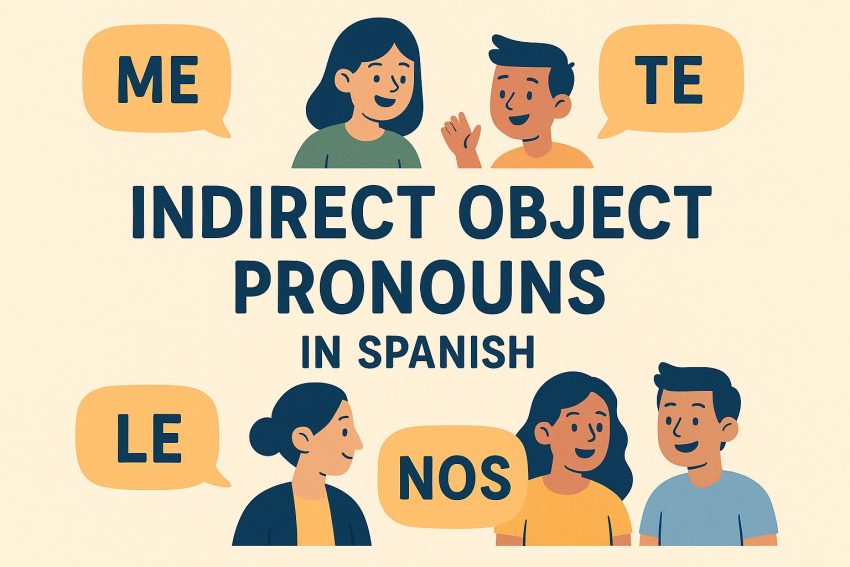
me – (to/for) me
te – (to/for) you
le – (to/for) him, her, or you
nos – (to/for) us
os* – (to/for) you all
les – (to/for) them, or you all
Notice that me, te, nos, and os are the same as their direct object forms. The difference appears only in le and les.
*os is primarily used in Spain; in Latin America, people use ustedes for “you all,” which takes les as the indirect pronoun.
How to use indirect object pronouns in a sentence
Using an indirect object pronoun in Spanish is simpler than it may seem. In most cases, the pronoun is placed immediately before the conjugated verb.
If there’s a verb phrase with an infinitive or a gerund, you can attach the pronoun to the end of those forms. Let’s look at some examples:
- Josu me regaló un libro. (Josu gave me a book.)
- me comes before the verb regaló (gave).
- Ella te dice la verdad. (She tells you the truth.)
- te comes before dice (tells).
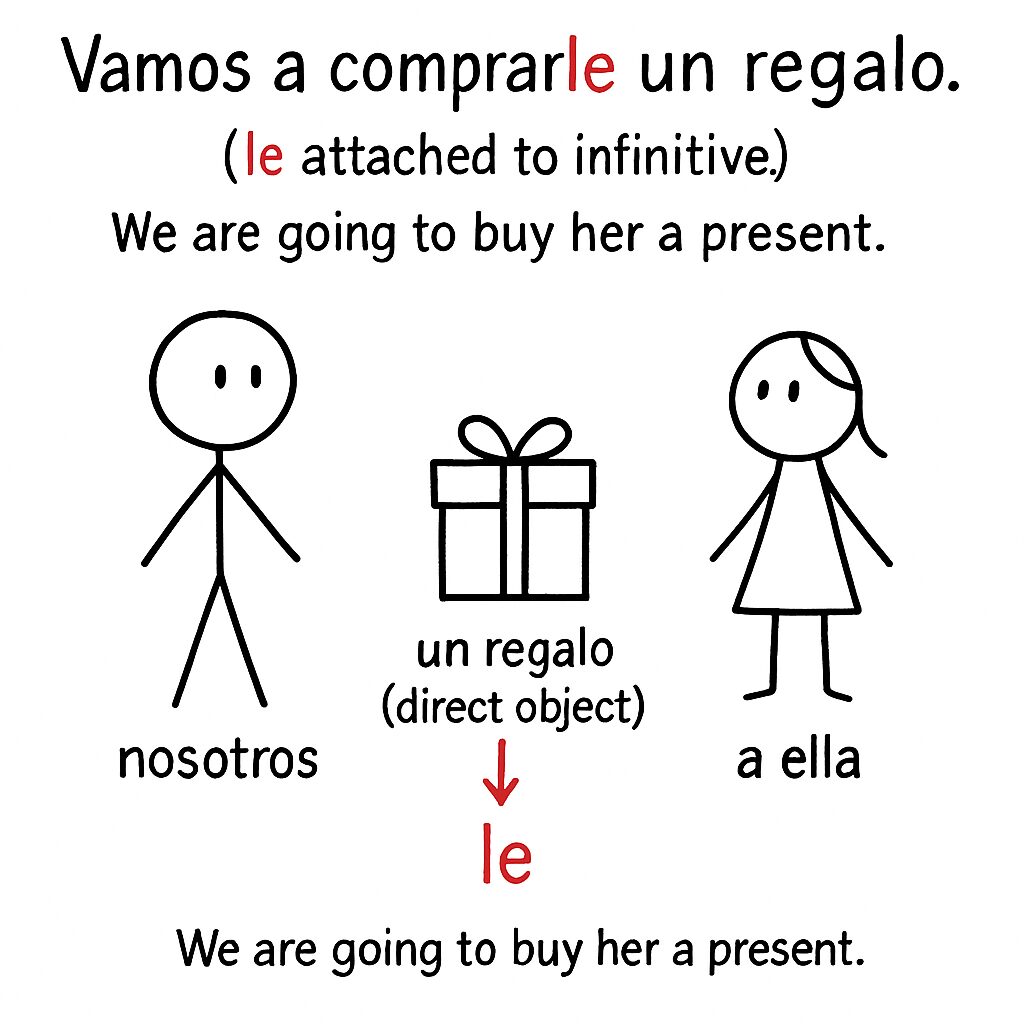
- Vamos a comprarle un regalo. (We are going to buy her a present.)
- Here, the pronoun le is attached to the infinitive comprar (forming comprarle). We could also say Le vamos a comprar un regalo – both ways are correct.
- Dime tu nombre. (Tell me your name.)
- In affirmative commands, pronouns attach to the end of the verb (dime = “tell me” in one word).
Spanish is quite flexible with pronoun placement in constructions with multiple verbs: you’ll often see both forms (attached or before the verb phrase) in everyday usage.
Just remember that if you do attach pronouns to an infinitive or gerund, you may need an accent mark to keep the stress (e.g., dámelo – “give it to me” – has an accent to maintain pronunciation).
It’s also worth noting that in Spanish, it’s common to use the indirect object pronoun even if the indirect object noun is mentioned in the same sentence.
For example, you can say:
A Juan le di el libro. (I gave Juan the book)
Literal meaning: “To Juan to him I gave the book.”
Spanish often keeps the indirect object pronoun le even when the person is named, for clarity or emphasis.
Since le/les don’t indicate gender or specific identity, adding the person’s name (or a phrase like a mi hermano, “to my brother”) helps avoid confusion. This duplication is perfectly normal in Spanish.
Using indirect and direct pronouns together (the “se lo” trick)
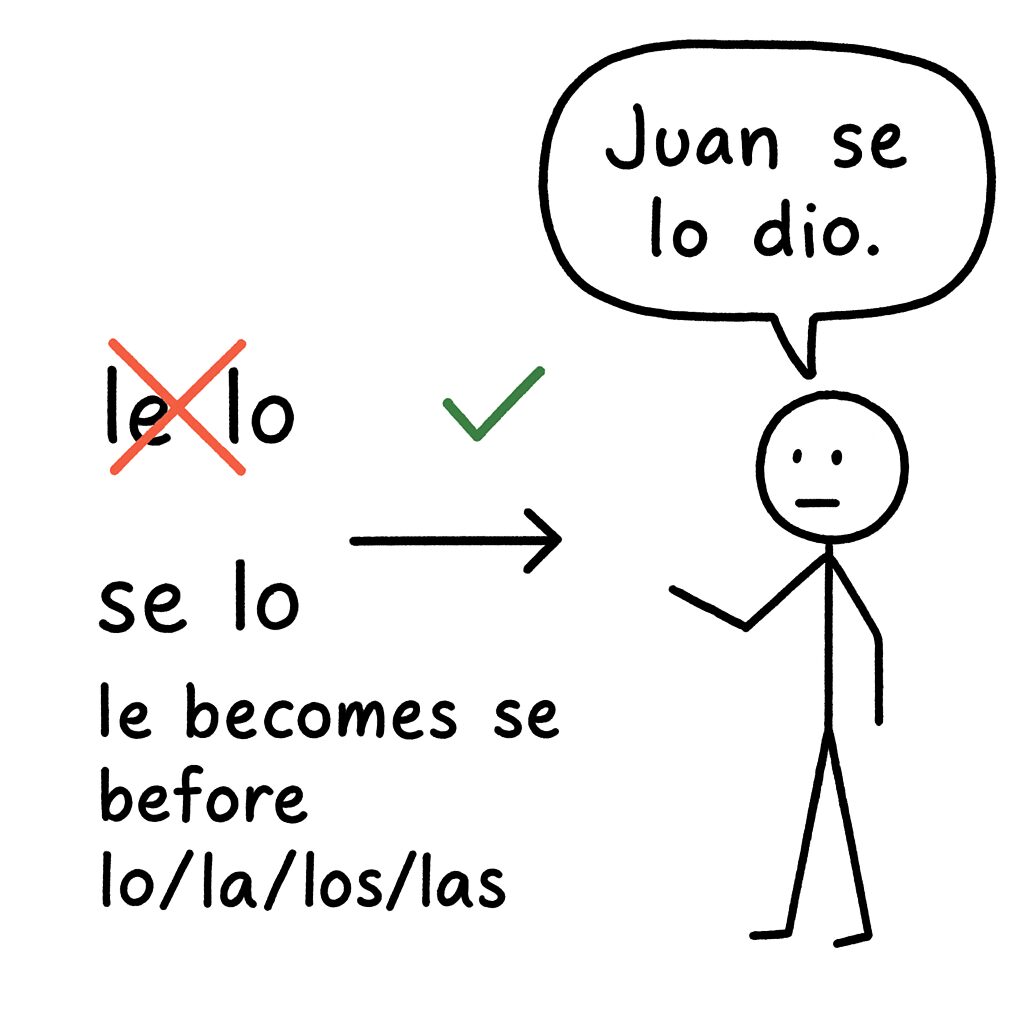
Sometimes you’ll need to use both an indirect and a direct object pronoun in the same sentence. For instance, “I gave it to her” – le di lo – presents a problem: Spanish doesn’t allow le lo together.
Le or les will change to se when followed by a direct object pronoun (lo, la, los, las). So “I gave it to her” becomes Se lo di.
The order is always indirect pronoun first, then direct pronoun (as in se lo): Andrés nos la contó – Andrés told it to us.
Common situations and verbs for indirect object pronouns
So, when do you use indirect object pronouns in Spanish? Basically, any time you’re talking about doing something to or for someone.
If a sentence has a recipient or beneficiary, you’re looking at an indirect object. You can either state the person outright or use a pronoun if the person is already known from context.
Here are some common verbs that often involve an indirect object:
- dar (to give): Le di el dinero a mi padre. (I gave the money to my father.) → Le di el dinero. (I gave him the money.)
- decir / contar (to tell, to say): Nos contó una historia. (She told us a story.)
- escribir (to write): ¿Me escribiste una carta? (Did you write me a letter?)
- mandar / enviar (to send): Te envié un mensaje. (I sent you a message.)
- regalar (to gift): Ellos le regalaron flores a Ana. (They gifted flowers to Ana.) → Le regalaron flores. (They gifted her flowers.)
In each case, someone receives something or is the beneficiary of the action – that’s when you know an indirect pronoun like me, te, le, etc., will be needed.
It’s also important to mention certain Spanish verbs that always use indirect object pronouns, even though their English equivalents might not.
The best example is gustar, which translates to “to like” but literally means “to be pleasing to.” So when you say “I like coffee” in Spanish, you actually say “Coffee is pleasing to me.”
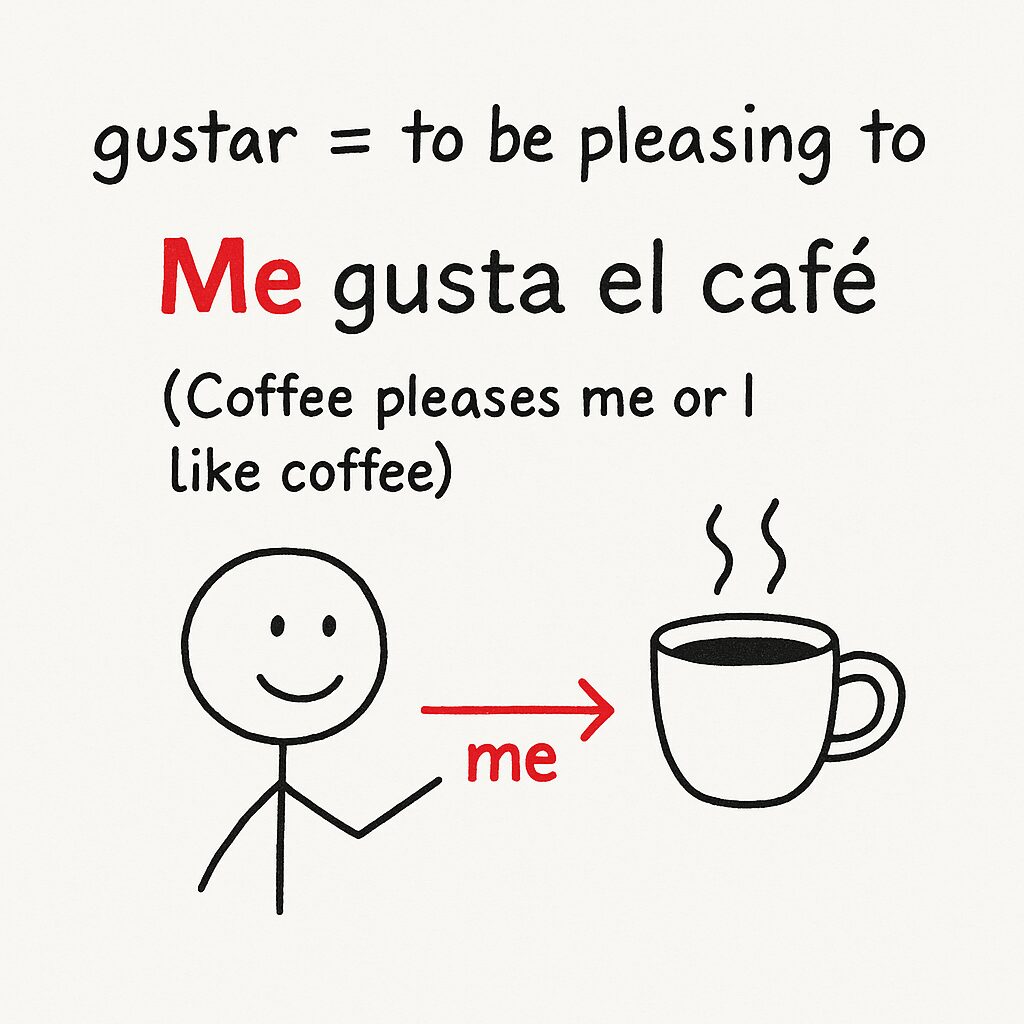
That’s why you say Me gusta el café (literally, “Coffee pleases me”). Here, me is an indirect object pronoun, even though we call it the subject in English.
Other verbs in this category include:
- encantar (to love/enchant)
- interesar (to interest)
- doler (to hurt, as in “to cause pain to”), etc.
Final tips
Here are some final tips for you to remember:
- To find the indirect object in a sentence, ask “to whom?” or “for whom?” the action is done. The answer will often be preceded by a or para in Spanish (e.g., a María, para mi amigo). That’s the part you’ll replace with an indirect object pronoun if needed.
- Don’t panic if a Spanish sentence uses both the noun and the pronoun (e.g., A Miguel le di un consejo). Redundancy is normal; it’s there for clarity.
- Remember that indirect pronouns don’t have feminine/masculine forms – le could mean “to him,” “to her,” or even “to you” (usted). Context or clarification (a él, a ella, a usted) will tell you which.
- Practice with common phrases: me gusta (it pleases me), te digo (I tell you), nos dieron (they gave us), etc. You’re likely using indirect pronouns more than you realize!
By understanding these basics of Spanish indirect object pronouns, you’re well on your way to mastering Spanish sentence structure. With a bit of practice, identifying who is receiving what in a sentence will become second nature.